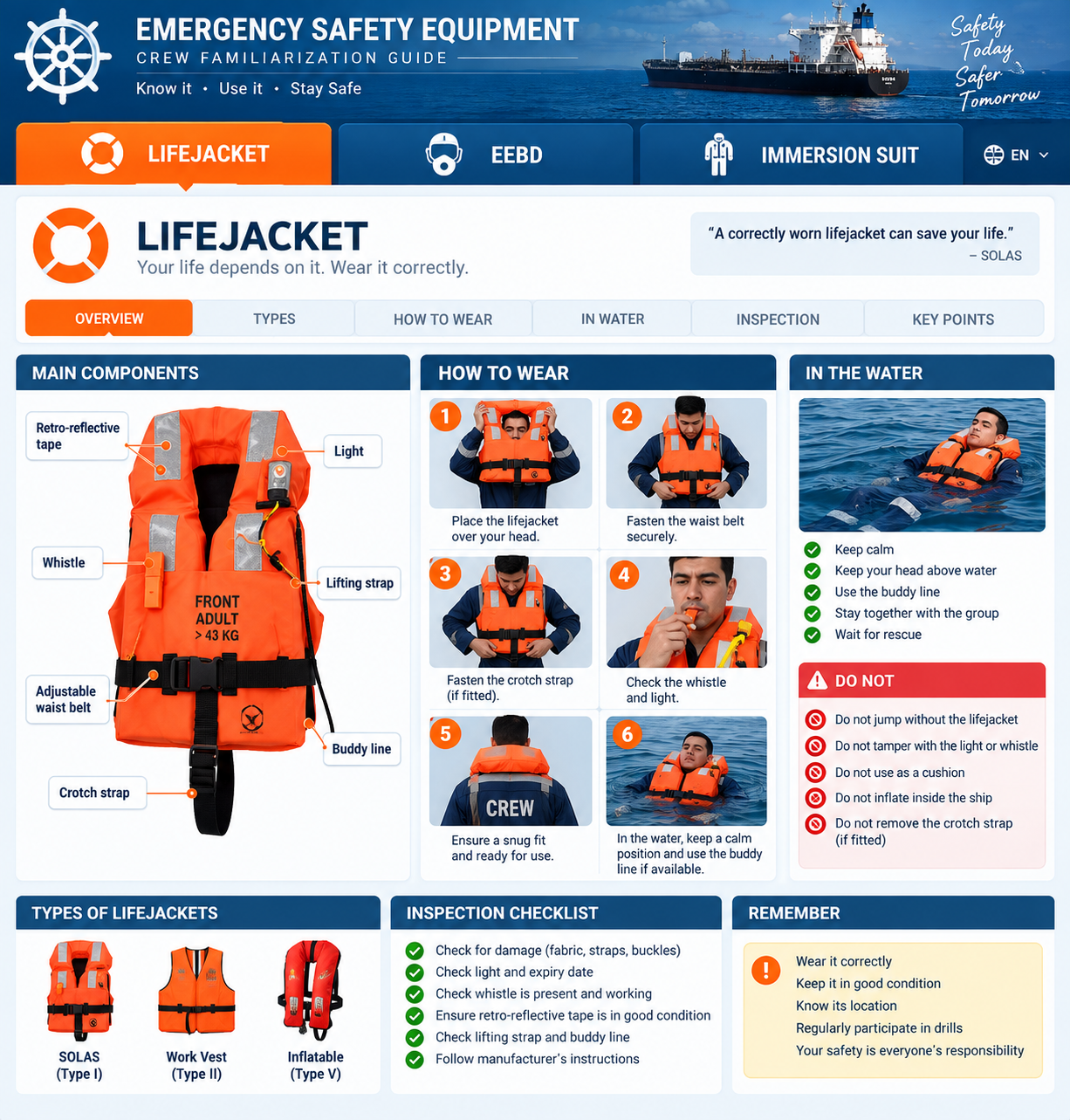
LIFEJACKET — How to Wear
1Take the lifejacket by the shoulders and unfold it.
2Place it over your shoulders, passing your head through the opening.
3Fasten the waist belt tightly.
4Adjust side straps for a secure fit.
5Check that it is properly fitted; keep whistle and light accessible if fitted.
6In the water: keep your head back, chin up, and conserve energy.
🟢 EEBD — Emergency Escape Breathing Device
⚠️ FOR EMERGENCY ESCAPE ONLY.
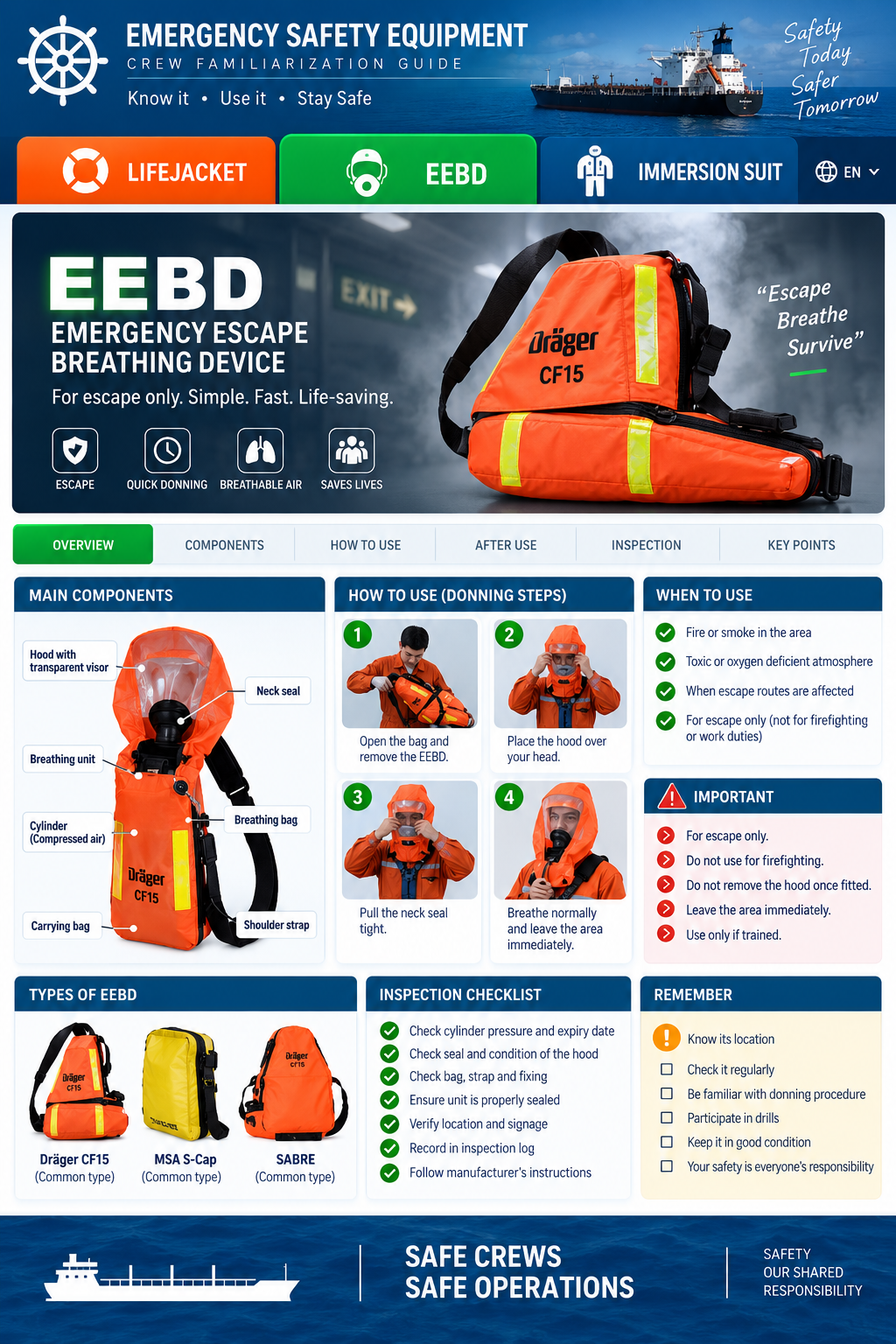
The EEBD is intended to assist escape from a hazardous atmosphere. Always follow the vessel’s SMS and the equipment manufacturer’s specific instructions.
🎯 What is it for?
The EEBD provides breathable air during escape from an area that may be contaminated or contain a hazardous atmosphere.
Key point: EEBD = ESCAPE. It is not intended for firefighting or for prolonged work in a hazardous atmosphere.
🔎 Before use
1Locate the EEBD and remove it from its stowage position.
2Visually check the condition of the equipment and its packaging, according to the model installed onboard.
3Identify the escape route and proceed toward a safe area.
🚫 Important: do not improvise or modify the equipment. In an emergency, follow the vessel’s procedures and the manufacturer’s instructions.
🫁 How to don it — step by step
1Remove the EEBD from its case.
2Open the package following the instructions for the specific model.
3Activate the air supply in accordance with the manufacturer’s instructions.
4Put on the hood correctly and adjust the sealing/strap system provided for that equipment.
5Check the seal and breathe normally.
6Escape immediately using the designated route. Do not stop unnecessarily.
🚨 During evacuation
- Remain calm and follow the escape route.
- Do not return for personal belongings.
- Do not remove the hood while you remain in a potentially hazardous atmosphere.
- Proceed to the safe area/muster station in accordance with emergency instructions.
❌ Mistakes to avoid
- Using the EEBD for firefighting.
- Entering a hazardous space to rescue another person without the appropriate equipment and procedure.
- Modifying or repairing the equipment during an emergency.
- Delaying evacuation while attempting to correct a problem.
🧠 QUICK CHECK
What is the primary function of an EEBD?
👉 To facilitate escape by providing respiratory protection while evacuating from a hazardous atmosphere.
🔵 IMMERSION SUIT
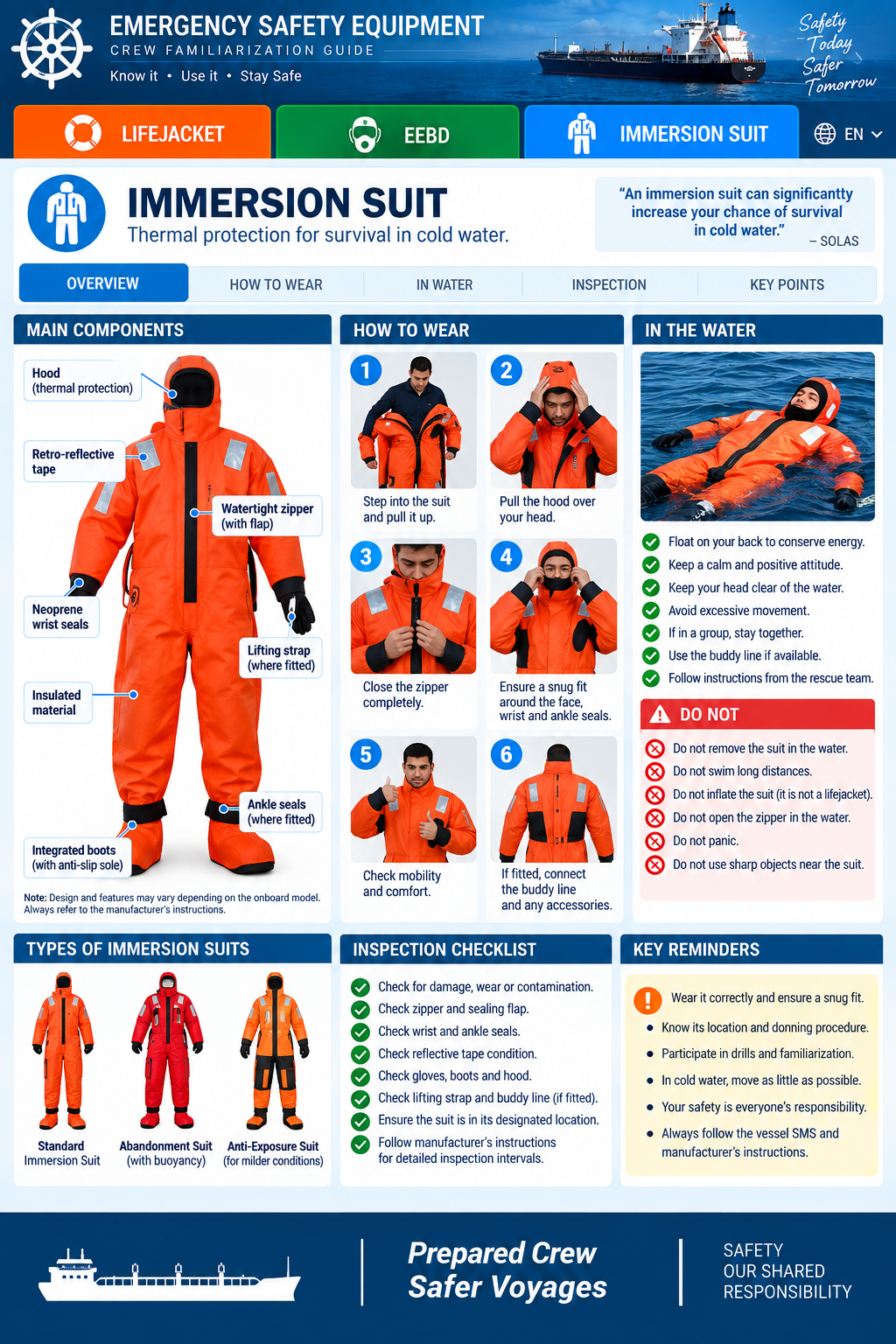
⚠️ PURPOSE: to help protect the wearer from cold-water exposure and support survival while awaiting rescue. Follow the vessel’s procedures and the manufacturer’s instructions.
🎯 What is it for?
The immersion suit is designed to provide protection during an emergency at sea, particularly against cold-water exposure, and to assist the wearer in remaining afloat while awaiting rescue.
Remember: PROTECT → FLOAT → SIGNAL → WAIT FOR RESCUE
🔎 Before donning
1Check that the size is appropriate.
2Visually inspect the suit and confirm that it is in good condition.
3Identify your muster station and follow the vessel abandonment instructions.
🧍 How to don it — step by step
1Open and prepare the suit for donning.
2Insert both legs fully.
3Pull the suit up to the shoulders and insert both arms.
4Fully close the front zipper.
5Fit the hood correctly, leaving the face exposed.
6Adjust the neck, wrist and ankle seals/straps, where fitted on the model.
7Perform a final check and follow the muster/abandon-ship instructions.
🌊 If entering the water
1Remain calm and avoid unnecessary movement.
2Adopt the trained flotation position and conserve energy.
3Stay with your group when safe to do so and follow instructions.
4Make yourself visible and use the available signaling devices as appropriate.
5Wait for rescue and avoid unnecessarily leaving a safe position.
❌ Mistakes to avoid
- Do not leave the zipper partially open.
- Do not use an incorrect size when a suitable size is available.
- Do not damage the suit with sharp objects.
- Do not force the zipper or seals.
- Do not unnecessarily leave a safe position while awaiting rescue.
🧠 QUICK CHECK
What should you remember when entering the water?
👉 Remain calm, conserve energy, stay afloat, signal, and wait for rescue.
IMPORTANT
These instructions are for training and familiarization. In an emergency, follow the vessel's muster instructions, SMS, emergency procedures and the equipment manufacturer's instructions.
Recommended vessel-specific additions: equipment model, onboard photographs, muster station, emergency contact, and short training videos.